Introduction
User expectations are changing faster than ever before. Today, digital products are expected to be easy to use, personalized, and seamless at each touchpoint. This presents an increasing challenge to UX researchers and product teams: how do you keep understanding users at scale, but also move fast enough to keep pace with modern product cycles? This is where AI agents are starting to revolutionize the future of UX research.
In recent years, artificial intelligence has evolved beyond just automation. Modern AI agents can detect trends, assess behavior, summarize user feedback, identify usability issues, and even help some parts of the design process in real-time. Rather than substituting researchers, these tools are allowing teams to move more quickly, gain better insights, and make smarter product choices with less manual effort.
AI-driven UX research is moving from an experiment to a competitive advantage as companies focus more on customer experience. In this article, we’ll explore what AI agents are, how they’re revolutionizing UX research processes, and what the best AI-powered research tools are in 2026.
What Are Artificial Intelligence (AI) Agents?
AI agents are intelligent systems designed to perform tasks autonomously through artificial intelligence, machine learning, and natural language processing. Unlike traditional automation tools, AI agents can learn from interactions, adjust to new environments, and make decisions based on contextual information.
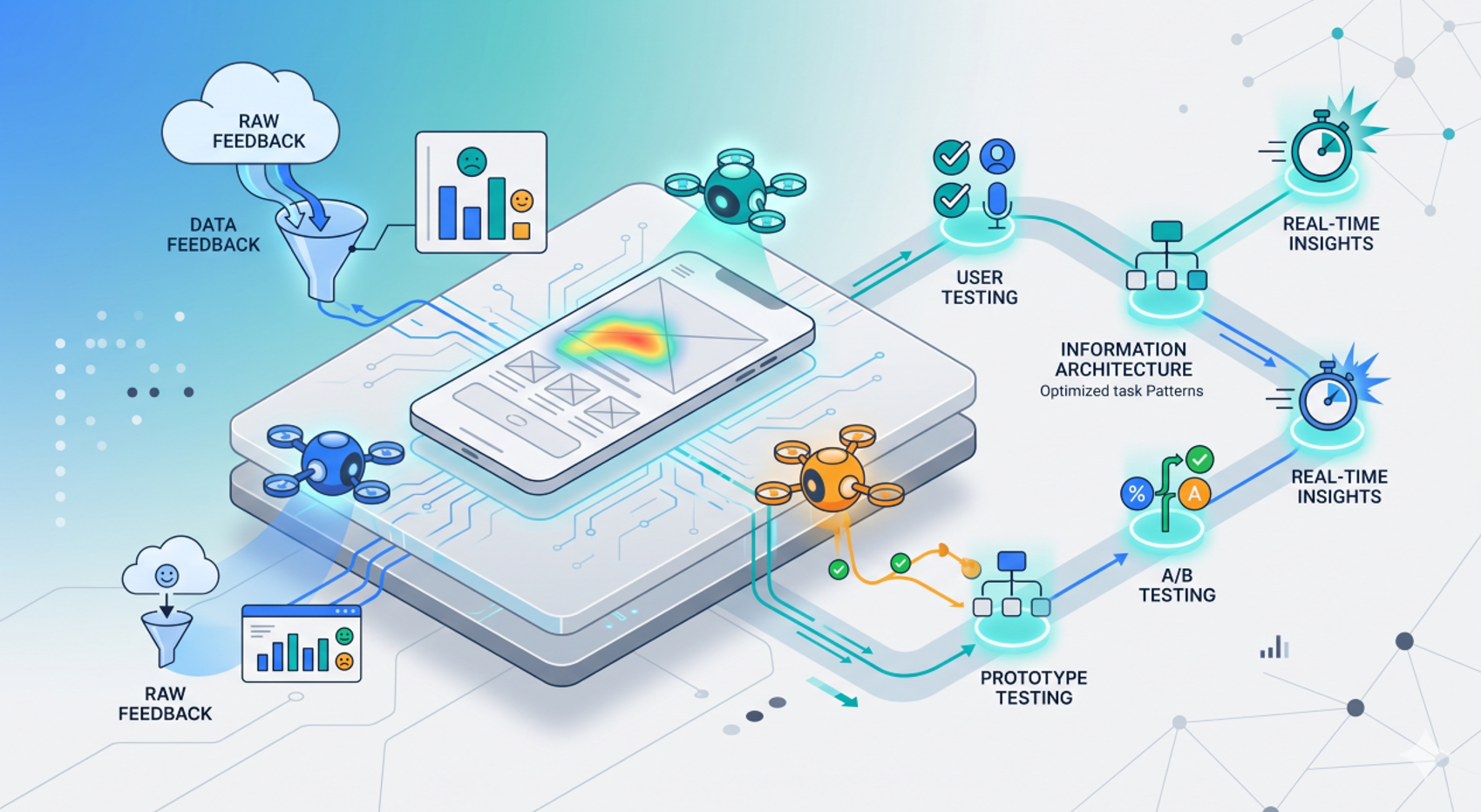
AI agents are changing the way organizations approach research and product development, from user testing to prototype testing, A/B testing, and mobile testing. With advances in custom AI agent development, teams can automate repetitive analysis, streamline experimentation, and turn feedback into actionable insights much faster. No longer do teams have to spend weeks sifting through files, creating spreadsheets, or manually marking user feedback.
Today, AI agents can process vast amounts of qualitative and quantitative data within minutes. UX researchers can use AI agent development services to collect, analyze, and understand user data faster and more effectively. They can spot behavioral trends, summarize interviews, draw insights from user testing sessions, and even suggest modifications to the design process.
For example, an AI agent can automatically identify moments when users had trouble, quit activities, or showed signs of disappointment, rather than having to manually watch dozens of usability test videos. That dramatically cuts down on research time, allowing teams to spend more time on strategy and problem-solving.
AI agents are also getting helpful in areas like:
- User testing
- Prototype testing
- Mobile testing
- A/B testing
- Benchmarking
- Website findability
- Information architecture
- Behavioral analytics
- Customer journey mapping
The idea is not to replace human researchers. However, human compassion, analytical thinking, and contextual awareness still are essential. AI agents are just intelligent assistants to help researchers move faster and find insights more effectively.
How AI Agents Are Changing the Future of UX Research?
1. User Testing Acceleration
Traditional user testing methods can be very time-consuming. Researchers will need to recruit participants, run sessions, review recordings, code feedback, and summarize results. AI agents are a huge help in alleviating this workload.
Today’s AI-powered research platforms can automatically transcribe interviews, detect sentiment, pull out usability pain points, and summarize insights. Researchers can dedicate less time to processing raw data and more time to improving the user experience. Researchers can dedicate less time to processing raw data and more time to improving the user experience. UX researchers can use AI agent development services to collect, analyze, and understand user data faster and more effectively. They can spot behavioral trends, summarize interviews, draw insights from user testing sessions, and even suggest modifications to the design process
AI agents are also helping to make unmoderated user testing more effective. Artificial intelligence systems can take the role of human moderators in many ways, including guiding participants through tasks, asking supplementary questions, and dynamically adapting testing flows according to user behavior. This enables organizations to perform research on a much larger scale without sacrificing speed or quality.
2. Site Visibility and Information Architecture Improvements
Many businesses are now collaborating with AI agent development companies to build websites that offer easy navigation for users. Simplifying the search process for users is a major obstacle in user experience design. Users get frustrated, leave, and don’t convert since the website is hard to find.
AI agents are assisting user experience teams in analyzing search activity, AI interactions, and navigation patterns in order to improve information architecture. Without these technologies, issues like poorly labeled data, confusing menu structures, or crowded channels could go unreported.
Redesigning navigation systems based on actual user behavior is now possible with the help of AI-generated behavioral insights, rather than depending just on assumptions. As a result, users have a more natural and pleasant experience navigating digital spaces.
3. Experimentation and A/B Testing Made Better
The use of A/B testing in user experience optimization is not new. Nevertheless, a lot of work and interpretation go into manually executing studies. As AI becomes more integrated into digital product development, branding and interface design are evolving as well. Many companies are now experimenting with AI-generated visuals, adaptive interfaces, and even dynamic AI logo that adjust based on user behavior and personalization preferences.
A lot of the work that used to be done by humans in experiments can now be done by AI agents. They are able to track user input, find results with statistical significance, suggest different versions of tests, and even foretell which design tweaks will boost performance.
Superior artificial intelligence systems can do more than just report which version performed better; they can also provide insight into why users reacted differently and propose improvements. Because of this, teams can iterate more quickly and confidently make design decisions based on data.
4. Smarter Prototype Testing
The use of artificial intelligence is making prototype testing smarter. Tools driven by AI can monitor user interactions with prototypes and pinpoint areas of flaws in task patterns. Upon completion of testing, some platforms go so far as to automatically generate usability reports. As a result, designers are able to validate concepts before development starts, drastically cutting down on feedback loops. Time and money saved during development without sacrificing quality is a win-win for agile product teams.
5. Real-Time Research Insights
In terms of user experience research, real-time analysis is one of the most cutting-edge developments brought about by an AI agent development company. Researchers used to spend days, if not weeks, after experiments ended just collecting the results. Intelligent bots can now continually scan across data and immediately provide insights.
For instance, AI-powered tools can spot repeated usability problems in mobile testing sessions with different users in real-time. The same real-time insights can also support content distribution by helping teams understand how users interact with digital experiences and where communication can be improved across platforms. Rapid response, prioritization of design fixes, and reduced decision-making periodsS are all possible with teams. Organizations may now create products that are more adaptable and user-centered thanks to this trend toward ongoing research. Businesses are also increasingly investing in web maintenance strategies to ensure that digital experiences remain optimized, secure, and aligned with evolving user expectations over time.
Best AI User Research Tools in 2026
With the rise of AI-powered UX research, a new kind of smart research platform has emerged. Here are some of the most notable AI-driven UX research tools influencing the industry in 2026.
1. Loop11
Loop11 is one of the top AI-driven user research and usability testing platforms that help organizations improve digital experiences with data-driven insights.
Loop11 enables user testing, prototype testing, mobile testing, benchmarking, and usability testing across websites and digital goods. The platform helps UX researchers and product teams to analyze how people interact with interfaces, discover friction points, and optimize customer journeys with more confidence.
It also offers an AI browser agent feature, allowing UX teams to detect task failures, improve AI systems with real human interaction data, optimize task execution, and continuously monitor AI performance in production environments. With the progress of AI in UX research, tools like Loop11 are helping businesses increase their testing capabilities while keeping the design process grounded in real user behavior
2. Hotjar
Hotjar is another platform for UX research and behavior analytics that helps companies map out how people use their websites and digital services. In order to find usability problems and make users’ experiences better, it provides tools including heatmaps, session records, questionnaires, and feedback widgets.
Researchers in user experience can utilize Hotjar to see where users click, scroll, or give up on a task while they’re using it. Websites’ discoverability, information architecture, and conversion optimization can all benefit from this.
Teams can assess data faster with the support of AI-assisted insights, which leads to more efficient and data-driven user testing and design decisions.
3. Maze
Maze is a popular tool for rapid product research and prototyping. It works nicely with design tools and helps teams to get input rapidly during the design process. The AI capabilities assist in simplifying findings and recognizing similarities among user responses, allowing researchers to work faster without losing accuracy.
4. UserTesting
UserTesting is still one of the more established platforms in the UX research space. Its AI-powered features include automated summaries, sentiment analysis, and smart insight recommendations. Particularly useful for enterprise teams doing large-scale user testing projects.
5. Dovetail
Dovetail is gaining traction for qualitative research analysis. Researchers utilize it to pull together interviews, user input, and usability findings into one workspace. Its AI capabilities enable it to automatically identify conversations, summarize topics, and reveal actionable findings from massive volumes of data.
Conclusion
AI agents are turning UX research into a faster, smarter, and more continuous practice, rather than the slow and reactive one it used to be. Teams are using AI-powered solutions to reveal insights more quickly and precisely – from user testing and prototype testing to A/B testing and information architecture.
As digital interactions get more advanced, companies need scalable solutions to learn about users and to constantly enhance products. This is enabled by AI-driven research tools that reduce manual tasks, improve decision-making, and accelerate the design process.
The future of UX research is not about replacing researchers with technology. “The goal is to provide researchers with better tools. The firms that will thrive in the coming days will be those that mix human-centric thinking with advanced AI technology to design experiences that really connect with users.

- UX Testing for SaaS Onboarding: Finding Drop-Off Points Before Users Churn - August 4, 2026
- How AI Agents Are Reshaping the Future of UX Research - June 16, 2026
- AI-Driven Usability Testing: Faster Insights Without the Manual Effort - May 25, 2026
 Give feedback about this article
Were sorry to hear about that, give us a chance to improve.
Error: Contact form not found.