Even though user experience (UX) design plays a key role in website performance, with a particular impact on a site’s ability to convert new and retain existing customers, its role in business growth is not merely limited to conversion potential.
In fact, it could be argued that UX design directly influences brand trust, a core brand characteristic that determines your ability to attract and engage prospects and lead them through the sales funnel.
After all, knowing that brand credibility is a key purchase-influencing factor in the modern buyer’s journey, with 88% of people saying it’s equally important to product value and quality, earning your target audience’s trust is a non-negotiable when aiming to grow your business. The great news is that solid UX design can be exceptionally helpful in this regard.
But how, exactly, does UX design influence trust? Moreover, can it genuinely make or break brand credibility?
In this guide, we’ll take a deep dive into the relationship between web UX and brand trustworthiness to identify the UX design hacks that will allow you to position your business in a positive light and get more customers thanks to the positive reputation of your brand. Let’s get into it.
Addressing the Technical Elements of Web Performance
The basis of exceptional user experience always begins with those aspects of design most business owners never even consider.
Site speed, mobile responsiveness, accessibility, information architecture, and site navigation are all core elements of a site that performs well and (more importantly) is enjoyable to use. Yet, the majority of websites fail to optimize for these aspects of UX.
In fact, if you explore some of the latest research on website technical performance, you’ll find that most sites are slow (with the average mobile site loading speed being a whopping 8.6 seconds), inaccessible (94.8% of website homepages have at least some accessibility issues), and lack user-friendliness.
And the thing is, while these issues may not seem like the end of the world, they directly diminish your site’s ability to convert new customers. Why? Because web users expect brands to provide them with enjoyable browsing experiences. And 75% judge brand credibility and competence based on web design.
So, if you’re looking for methods to help position your organization as a credible, competent, and professional entity in your target industry, invest in your site’s appearance and performance.
You don’t have to go overboard with innovative UI elements or think up complex UX solutions. In fact, a minimalist approach — like the one employed by Wise — is much more likely to work in your favor. However, do pay attention to technical performance indicators and use every opportunity you can to make interacting with your website as easy and enjoyable as possible.
Source: wise.com
Positioning Trust Signals: Choosing a Page Layout for Maximum Credibility Impact
When aiming to earn your target audience’s trust, keep in mind that they won’t instantly believe you when you claim you’re a credible and competent business. Instead, they’re quite likely to do their own research.
In fact, if you look at consumer behavior insights, you’ll find that most consumers do some amount of brand and product research before committing to a purchase.
According to PowerReviews, for instance, 95% of people regularly read reviews before making a buying decision. And 96% consider social proof to be a key consideration in informing their buying behavior.
With this in mind, it’s essential for your website to include high-quality, relevant social proof that can convince your target audience to perceive your brand as a competent entity, which can resolve their pain points.
Additionally, you can employ UX design to position such elements in the right areas — where they’re not just likely to be noticed by web visitors but appreciated as well.
A good rule of thumb is to concentrate social proof elements in high-value areas of your website where visitors are guaranteed to look during their browsing journey.
For example, knowing that the majority of people’s total web browsing time is spent looking at content in the topmost section of a page, doing something similar to Uproas — a brand that fills its hero section with lots of trust-building elements — makes perfect sense.
 Source: uproas.io
Alternatively, you could choose to feature social proof in areas where your visitors need trust-building content the most.
In most cases, this involves moments of the browsing journey where visitors need reassurance that a conversion will pay off. This can include trust signals next to CTA buttons or on product collection pages, especially when aiming to help buyers choose the right product for their needs.
Optimizing Navigation Mechanisms: Preventing User Frustration
When landing on your website, visitors want to have an easy experience discovering information relevant to their position in the buyer’s journey. Yet, one of the biggest UX design mistakes brands make is failing to optimize website navigation mechanisms for user-centricity.
If you look at research on how subpar website navigation influences user experience, you’ll find that twice as many people become frustrated due to poor web navigation as those who are triggered by typos or content mistakes.
Admittedly, at first glance, this may not seem that impactful when aiming to elevate brand credibility.
But here’s the deal. Allowing web visitors to become frustrated while browsing your website doesn’t just run the risk of them leaving your site without turning into customers. It also opens up the possibility of them associating this frustration with your brand, significantly diminishing their willingness to interact with your business in the future.
With this in mind, explore opportunities to make product and content discovery seamless and user-centric.
For example, brands that use product finder quizzes — such as Josie Maran, which helps web visitors discover the perfect fragrance for their needs — don’t just earn customer trust by offering relevant educational value to people who answer the questions. But they also intentionally guide prospects through the sales funnel, gently nudging them toward a conversion and earning their business thanks to a high level of user-centricity-driven brand confidence.
Source: josiemaran.com
Content User-Friendliness: Making Visitors Want to Learn More About Your Offer
Earning customer trust largely depends on your capacity to prove the value, effectiveness, and relevance of your solutions. Ultimately, if your prospects perceive your offer as a good way for them to resolve pain points, they’re more likely to see your business as credible and competent.
With this in mind, investing in resources that boost product understanding in a user-centric way is key to building brand credibility.
But here’s the deal. Not all content formats have the same success rate in terms of engaging web users.
In fact, one of the most recent consumer behavior trends is an increasing demand for video content. According to research, the majority of web users prefer to learn about products via video instead of text.
When looking to employ UX design to elevate brand credibility, explore opportunities to use content formats your audience wants to consume, to boost their chances of comprehending the value you offer.
For instance, look at how GetSafe implements this UX design tactic. Instead of forcing web visitors to read several paragraphs to understand what the product does, this brand describes its main benefits and functionalities through an engaging (and humorous) short video. This choice is exceptionally user-friendly and engaging. Additionally, it’s an excellent way to avoid user frustration and ensure visitors stay on the page long enough to perceive GetSafe’s offer as a good way to resolve their pain points.
 Source: getsafe.com
Preventing Skepticism in Low-Trust Niches — Adding Verification to High-Value Web Elements
In some cases, proving your brand’s credibility can be more difficult than you anticipated. This is particularly common in low-trust industries and when selling innovative solutions that your target audience doesn’t understand (yet).
In these cases, traditional social proof can be a good method of elevating brand trust. But it may not always be enough.
Fortunately, you can easily overcome this conversion obstacle by simply adding a verification element to high-value web elements needed to earn your audience’s confidence.
For instance, this can be as easy as stating that a reviewer is a “verified customer,” which is what Performance Lab does in the social proof section of its homepage. Or, you could go even further and showcase third-party certificates, UGC, or industry-specific awards your business and/or products have earned throughout the years.
Source: performancelab.com
Addressing and Meeting Common Customer Experience Demands: Creating Reassurance
Another easy method to employ UX design to drive brand trust is to explore opportunities to address and highlight customer experience benefits relevant to your target audience.
If you think about it, CX is one of the main reasons why consumers choose to purchase from specific businesses. In 2025, 77% of people expect convenience, speed, ease of availability, and accessibility.
So, if you can use design to position your business as an organization that can deliver on all of these points, you can rest assured that your target audience will happily choose to buy from you.
Of course, implementing this design tactic requires some nuance. After all, bombarding web visitors with CX benefits might pay off. However, it might also appear as an aggressive sales tactic and cause them to see your brand as too sales-oriented.
So, to ensure your efforts translate into brand confidence and higher conversion rates, explore ways to advertise sought-after CX benefits during the exact stages of the browsing/buying journey in which they’re relevant.
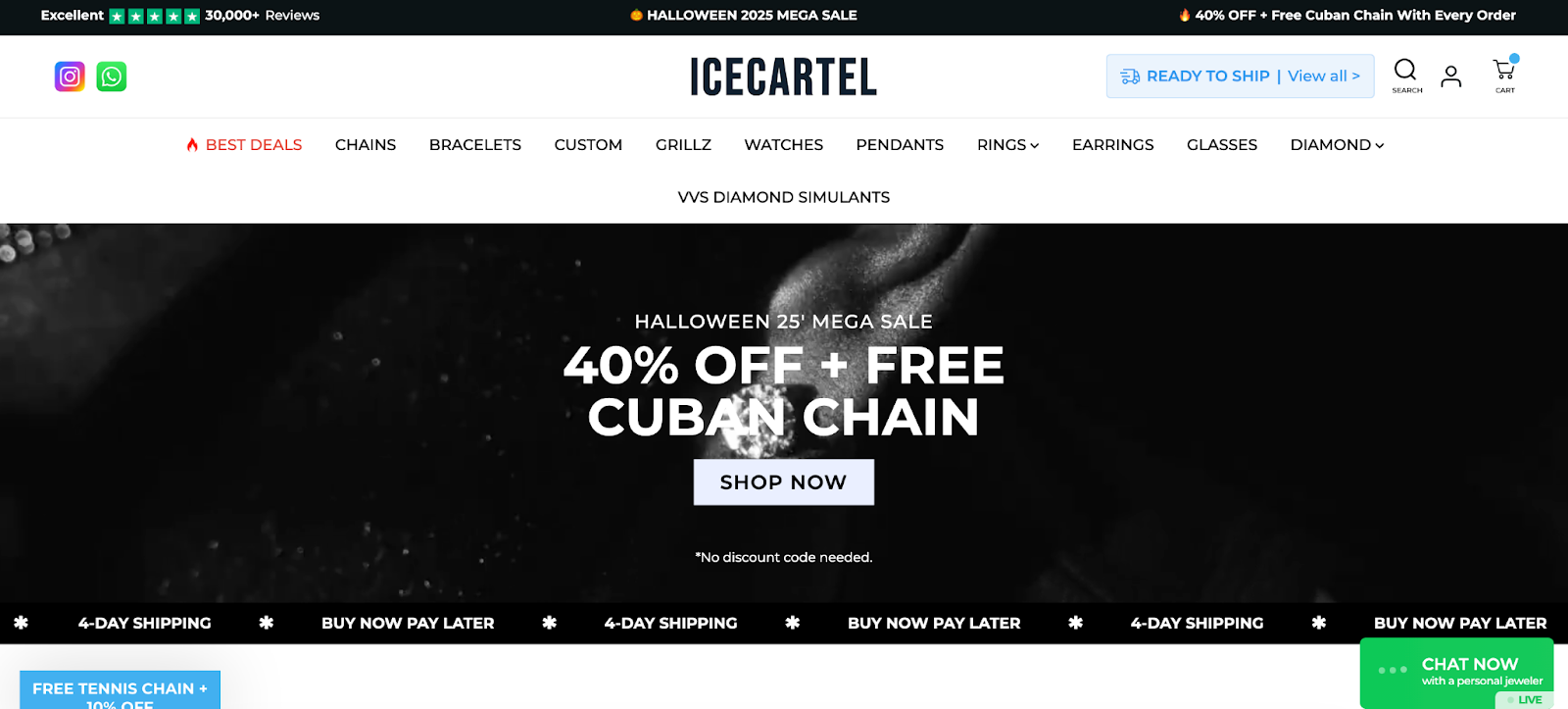
For instance, when prioritizing conversion-oriented messaging because you’re advertising a sale — like Icecartel in the example below — make sure to position CX benefits as a significant part of this special offer. Sure, this brand includes BNPL options and 4-day shipping with all its products. Nevertheless, it understands that shopping during special sales can often feel like an impulsive decision to buyers. So, instead of allowing web visitors to talk themselves out of a purchase, IceCartel uses design to strengthen their purchase intent with credibility-inspiring value propositions that also drive conversions.
Source: icecartel.com
Implementing Personalization: Using Hyper-Relevance to Demonstrate Dedication to Customer Satisfaction
Lastly, if you’re looking for design tactics that can elevate user experience on your website, don’t forget about personalization.
Nowadays, most consumers want personalized, hyper-relevant brand interactions. In fact, 76% become frustrated when companies fail to deliver personalized experiences. Plus, 81% of people actively ignore irrelevant marketing messages.
But here’s the thing. Incorporating personalization into your web design isn’t just a way to ensure your audience is willing to hear your pitch and enjoys interacting with your brand. It also demonstrates your brand’s identity as a company that cares about its customers and is capable of meeting their needs.
So, if that’s the type of credibility you’re trying to establish, explore methods to make your pages personalized. No, you don’t have to utilize advanced design strategies. Even something as simple as adjusting your pop-ups to reflect your visitors’ interests — which is what Business for Sale does on its Adelaide business listings page — can be sufficient to help your prospects see you as competent and trustworthy.
 Source: businessforsale.com
Final Thoughts
As you can see, how you present information on your website can make or break your attempts to position your business as a credible entity.
But the thing is, brand trust is a non-negotiable driver of purchase intent in 2025. So, you’ve got no choice but to do your best to earn your audience’s confidence.
The strategies outlined in this guide are a great way to solve this common design issue. Implement them as is or adapt them to your brand’s (and audience’s) specific needs. In any case, you’re guaranteed to see a positive improvement in your brand’s reputation. And that may just translate into more conversions and an easier way of reaching and engaging future customers.

- Selling Specialized Products: 6 UX Strategies for Educating and Converting Customers - August 11, 2026
- How UX Design Shapes Modern Customer Trust - June 23, 2026
- Reducing Cognitive Load: How Simpler UX Drives Better Outcomes - April 20, 2026
 Give feedback about this article
Were sorry to hear about that, give us a chance to improve.
Error: Contact form not found.