It’s no secret that UX research is having a moment. In 2025, it’s not just about testing usability or validating ideas after launch — it’s about shaping products from day one. As teams move faster and users expect more, understanding real behavior, needs, and context has become non-negotiable.
This article dives deeper into the biggest UX research trends we’ve seen here at our agency – right from AI tools being used to accelerate the process, to a more inclusive user research & testing process led by global participant recruitment.
If you’re trying to keep your product team sharp, thoughtful, and ahead of the curve – this article will give you a closer look at some key trends they need to keep track of.
So let’s dive right in.
Why UX Research Matters More Than Ever in 2025?

The UX landscape in 2025 has changed dramatically. What started as a way to improve interfaces has now become a strategic business function that affects organizational success.
Let’s take a closer look at why UX research matters more than ever before.
- Emergence of UX research as a business asset
UX research in 2025 has surpassed its traditional role of testing interfaces. Organizations now know that strategic UX research is a vital bridge between user needs and business objectives. This helps create lasting growth in a changing market.
The change comes from knowing that research affects three main business pillars: better customer satisfaction, lower costs, and higher revenue streams.
Product-market fit (PMF) has become central to UX teams. Marc Andreessen, a venture capitalist, made this concept popular. It happens when a product meets strong market demand through growing sales and more users.
The best teams now use UX research to verify if a product solves real problems before they invest much in development.
“Without usefulness, there is no user desire, no customers, no sales, no recommendations, and no growth,” notes a UX professional in a recent industry publication.
Then, teams that use research in all operations see 2.7X better business outcomes — including higher revenue growth and better customer retention.
- Faster product cycles & rising user expectations
Teams can no longer wait weeks for usability reports or post-launch surveys. Product speed now needs real-time feedback that goes straight into development cycles. This has pushed UX research to become more flexible and responsive.
The need for UX research keeps growing despite economic changes. A recent report shows that 55% of respondents in the survey reported an increase in demand for research. This steady growth shows how companies understand research’s role in creating better products and business strategies.
Modern agile product strategy depends on quick, iterative research. The 2024 ProductBoard Product Excellence Report shows teams using continuous discovery have 2X faster release cycles and 30% higher feature adoption.
Weekly or bi-weekly quick tests, along with always-on user listening channels, have become standard practice.
- Bridging qualitative and quantitative methods
The most important change in UX research has been how qualitative and quantitative methods work together. The old divide between these approaches—where quantitative research showed what users did at scale while qualitative insights explained why — is getting smaller faster.
Teams that use only one approach risk missing the full picture. Quantitative-only research leads to optimizing what’s measurable, not what matters. Qualitative-only magnifies stories over action. Successful teams now design feedback loops where quantitative findings guide qualitative exploration, and qualitative discoveries become testable hypotheses.
This hybrid model has become the norm. A recent User Experience Professionals Association (UXPA) survey found that 78% of organizations now do hybrid research. This approach creates continuous feedback and speeds up insights.
On top of that, this integration creates a more complete approach. Teams don’t just fix surface problems—they find deeper truths, spot needs early, and design for real impact.
Companies that mix quant and qual well cut down on failed launches and welcome innovation by finding “unknown unknowns.”
Looking ahead to 2026, industry leaders won’t be the ones with the most data. Success will come to those who connect numbers with deep human understanding. The bridge between numbers and narratives gives companies an edge in our complex marketplace.
Key UX Research Trends to Look Out For in 2026
Given below are some of the key UX research trends to watch out in 2026:
- AI‑Assisted UX Research Going Mainstream

AI has evolved faster from an experimental technology into a key component of modern UX research practices. AI-assisted research methods have become mainstream in 2025. This shift has changed how teams gather and analyze user insights.
What it all means – AI tools help with sentiment analysis, automated interview coding, pattern detection.
UX researchers now depend on AI to process and analyze big amounts of qualitative data. Manual coding of interview transcripts is a thing of the past. AI tools now transcribe user sessions with remarkable accuracy.
They identify key themes and detect emotional responses that human researchers might overlook.
These tools make research much more efficient. Research shows AI cuts qualitative analysis time by up to 80%. Researchers can now focus on strategy and insight generation instead of tedious coding tasks. AI also spots patterns across large datasets and reveals trends that manual detection would miss.
Key applications of AI in UX research include:
- Sentiment analysis – AI algorithms assess emotions conveyed in text inputs, classifying sentiment as positive, neutral, or negative.
- Automated interview coding – Systems tag and categorize research findings, identifying common themes across multiple sessions.
- Pattern recognition – AI detects recurring behaviors and priorities in user data, revealing insights that might otherwise remain hidden.
These capabilities show up in tools that analyze transcript data from user interviews. They automatically point out key moments and create summaries that researchers can quickly review and confirm. AI-powered analysis tools excel at processing large volumes of qualitative data. This makes it possible to scale research efforts without spending more time.
Major agencies like ours have quickly adopted AI-powered research methodologies, with most innovative teams leveraging AI to find insights that traditional methods might miss.
Their approach uses AI-assisted analysis of support tickets, social media sentiment, and app store reviews. These data sources contain valuable user feedback but often remain unused due to information overload.
Several emerging trends will shape how AI transforms UX research practices in 2026. AI-generated representations of user groups called predictive personas lead this change. These evolve based on immediate behavior data.
These dynamic models update continuously as new data comes in. This creates a more accurate and nuanced picture of user needs. University researchers are learning how vector personas—a method that combines AI with traditional qualitative techniques—can build more complete user representations.
Generative research briefs will likely become common practice. These AI-generated documents combine existing research, find knowledge gaps, and suggest methods for upcoming studies. All this aligns with specific business goals and user needs.
Ethical concerns will grow alongside these advances. One researcher points out, “The most dangerous thing about AI in UX is how easily it normalizes opaque decision-making”.
Teams must think about bias, transparency, and informed consent as AI becomes more integrated into research processes.
All in all, AI’s future in UX research lies in magnifying human researchers’ capabilities, not replacing them. This helps them work with increased efficiency, gather detailed insights and create better user experiences.
- Research Becomes Multi‑Team & Organization‑Wide
UX research is no longer limited to specialized researchers. The year 2025 brings a revolution as teams across organizations take on research responsibilities. This change marks one of the deepest shifts in how companies learn about their users and make decisions.
Cross-functional teams now conduct their own research activities as UX research becomes more democratic. Recent data shows designers (70%), product managers (42%), and marketers (18%) actively gather user insights. This marks a complete departure from earlier days when dedicated UX teams worked in isolation.
Data scientists have become valuable allies in this expanded research ecosystem. UX researchers team up with data scientists to paint a complete picture of user behavior. Researchers uncover “the why” behind user needs while data scientists analyze “the what and how many” through performance metrics and statistical models.
Express Scripts offers a great example. Their UX researchers teamed up with the data science team to build an internal participant panel.
The system lets researchers independently recruit specific participants. This teamwork shows how different groups can use their strengths together.
This multi-team approach usually creates deeper insights because different viewpoints boost the research process. Developers might ask about technical feasibility, while marketers focus on brand perception. The result is a better understanding of users.
- Embedding research in workflows
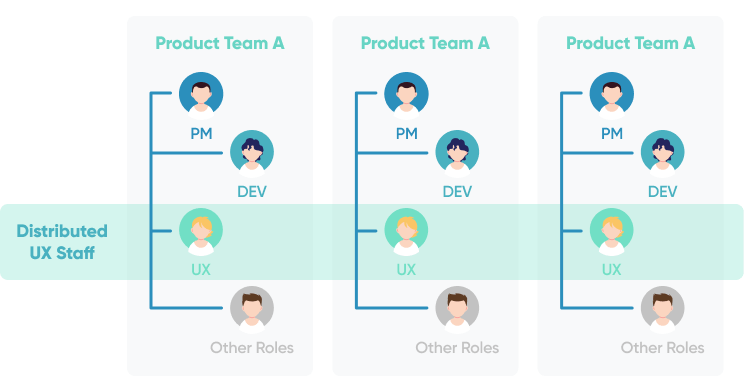
Organizations adopt three main models as research spreads across teams:
- Centralized teams – All UX professionals report to a UX manager and work as consultants across the organization.
- Decentralized teams – Researchers are embedded directly within product teams.
- Matrix (hybrid) models – Researchers report to both a UX manager and a product team lead
Each model brings unique benefits. The embedded model has gained popularity because it builds stronger partnerships and deeper product knowledge. Atlassian moved from a “Research as a Service” model to an embedded approach. This change helped researchers build better domain expertise and stronger bonds with product teams.
Some organizations choose hybrid structures. They place some researchers within teams while others handle cross-departmental strategic projects. This balanced approach allows both deep product expertise and broader organizational impact.
Teams have also found ways to optimize research workflows through automation. Zapier’s researchers use webhooks to automate participant recruitment, scheduling, and reminder emails.
Keeping these aspects in mind, the future of multi-team research in 2026 will likely be shaped by several trends:
- Self-service research platforms like Loop11, Maze and UserTesting will become more popular. Non-researchers will conduct simple studies on their own. These platforms offer templates, guidance, and guardrails to ensure quality. This frees dedicated researchers to tackle more complex strategic work.
- “Citizen researchers” will grow in numbers as organizations provide training and support. Successful programs will include mentorship, research playbooks, and continuous learning resources to help team members across disciplines improve their skills.
- Embedded UX researchers in business units will become common. Researchers will develop expertise in specific domains. These embedded experts will both practice and teach, helping teams build research capabilities while maintaining quality standards.
All the same, Research Operations (ReOps) will become crucial in this distributed landscape. ReOps teams will create frameworks, governance models, and quality control measures to maintain research integrity across the organization.
What lies ahead isn’t about choosing between specialist researchers or democratic approaches. The key is finding the right balance – building ecosystems where everyone helps understand users while maintaining excellent research standards.
- Hybrid Methods: Remote + In‑Person + AI
Hybrid methodologies have become a game-changer in UX research by combining the strengths of multiple approaches. Teams in 2025 no longer see research methods as binary choices. They blend remote testing, in-person research, and AI-powered analysis to get informed insights.
Hybrid research in 2026 will focus on bridging the gap between quantitative and qualitative insights. New visualization techniques will show mixed-method data in ways that make connections clearer. Teams will understand not just what happens but exactly why and how to respond.
- Speed & Scale: Research at Agile Pace
Speed has been significant in product development. In 2025, we’re seeing a fundamental change in how UX research combines with agile processes. This rise tackles the ongoing tension between quick movement and building the right product.
Companies are moving away from the traditional “time-to-market” focus to a more nuanced “time-to-right” approach. This change recognizes that being first matters less than delivering the right solution that truly meets user needs.
Progressive teams now integrate UX research directly into agile sprints through:
- Continuous discovery – Small, frequent research sessions run throughout the product lifecycle instead of separate phases.
- Rapid prototyping – Design testing during development with lightweight methods.
- Just enough research – Getting sufficient insights to verify that changes meet sprint goals without new problems.
Unmoderated usability testing proves valuable especially when you have teams that need to collect insights without slowing development cycles.
That being said, the integration of research with development will deepen by a lot as we look toward 2026. Continuous feedback loops will become standard practice. Always-on user listening channels will replace periodic research projects.
Live dashboards showing user insights will change decision-making processes. These dashboards will work as “living maps” for product teams and highlight risks, roadblocks, and chances as they emerge.
Research will become embedded directly in continuous integration/continuous delivery (CI/CD) pipelines. UX testing will work as an automated checkpoint within these systems. This ensures quality while reducing human intervention.
The most advanced organizations will eliminate the false choice between speed and quality by 2026. They will create efficient workflows where research continuously shapes development at every stage.
- Inclusive & Ethical Research Gains Ground
UX research has transformed in 2025 as inclusivity and ethics became its life-blood, representing a fundamental change in how organizations learn about their users. This trend reflects both moral imperatives and business necessities. Companies now realize that diverse research participants create better insights and products.
Leading UX teams now recruit participants from a broader spectrum of abilities, backgrounds, and locations. Studies reveal that 15-20% of the world’s population lives with some form of disability.
This creates an enormous market segment companies can’t ignore. The global population includes 15-20% neurodiverse individuals, which makes inclusive research essential.
Companies that think ahead prioritize on-site sessions while conducting usability testing with participants who use assistive technology. This lets people use familiar technology. Research with screen reader users yields authentic insights through sessions at their homes or offices rather than lab-based testing.
That being said, several trends will raise inclusive and ethical research practices in 2026:
- Global research panels will grow more sophisticated. Better infrastructure will help recruit and compensate participants from underrepresented markets. Core research teams will partner with regional specialists who bring deep cultural knowledge to ensure relevance.
- Ethics will become a strategic differentiator. Organizations will promote their research integrity as a competitive advantage.
- Trust from users and business partners will grow for companies that show commitment to ethical research.
- Researcher Role Evolves: From Executor to Educator
Research teams face growing pressure as requests continue to exceed their capacity. UX researchers can support barely half of all research requests they receive. This forces them to prioritize and find alternative approaches. Research teams now focus on training others while reserving their specialized skills for complex strategic work.
Caroline Jarrett’s words ring true: “user researchers’ job is not to learn about users, but to help their teams learn about users”. This philosophy turns researchers into educators who build research capability throughout organizations.
Successful organizations actively train their teams through:
- Lunchtime sessions explaining research fundamentals
- Dedicated workshops on research techniques
- Interactive exercises that demonstrate research value through practice
Evidence shows that teams who embrace this shared approach to research create better products faster and address customer needs effectively.
That being said, 2026 will see more researchers become “insight platform owners” who create and maintain centralized knowledge systems. These systems will democratize access to user understanding through living repositories that connect insights across projects and teams.
Researchers will also evolve into dedicated change agents. Their focus will shift from informing decisions to driving strategic change by helping organizations adopt more user-centered approaches to business challenges.
Industry veterans believe that “UX researchers hold the key to creating empathy with users, which helps get the entire organization engaged in solving users’ pain points”. The skill to encourage organizational empathy will become increasingly vital.
- Remote-first & Global Participant Recruiting
Researchers can now capture insights from markets they couldn’t reach before through global participant recruitment. Digital products serve users worldwide, and limiting research to one region creates dangerous blind spots in understanding. Research teams can now access participants from different locations, which leads to richer, more representative data.
“Without diversity in your test participants, you risk building products that only work for a subset of your target audience,” notes a senior UX researcher at a multinational tech company.
Finding relevant niche audiences has become vital for detailed UX research, especially when targeting specific global markets or demographics.
Major user research agencies too, have rebuilt their recruitment process to handle global studies. Teams will need to think about language barriers, cultural nuances, and differences in technical infrastructure to work internationally.
Moreover, AI too, will reshape the scene in 2026, by analyzing behavioral data to predict which participants fit specific studies best. This approach will cut down screening time while bringing in better participants.
Continuous user panels will grow into always-on research networks where participants give ongoing feedback through various touchpoints. These panels will serve as living laboratories and give researchers live insights into changing user behaviors and priorities.
Organizations will adopt an “always-on” research approach more widely by 2026, helping companies gather insights throughout product development cycles instead of at specific points, which creates more responsive and user-centered products.
Conclusion
UX research has without doubt grown from a specialized function into a vital force that drives business success. The year 2025 saw this progress speed up in seven key areas—from AI-assisted methods to global recruitment. Teams that welcome these changes now gain competitive advantages instead of just keeping up with others.
Your organization should get ready for deeper integration of these trends in 2026. AI systems will become more sophisticated yet transparent. Hybrid methods will create uninterrupted cross-modal processes, while researchers will take on roles as strategic educators and change agents. Ethics and inclusivity will become real differentiators in how companies understand their users.
Moving forward requires a balance between technology and human insight. The future of UX research doesn’t force a choice between specialist expertise and democratized approaches. It thoughtfully combines both to create environments where everyone adds to user understanding while maintaining research quality.
The real question isn’t about adopting these practices — it’s about how quickly you can blend them into your processes to be proactive in this competitive field.

- 8 Key UX Research Trends Shaping 2025 (and What to Watch in 2026) - November 10, 2025
- 9 Ways to Use AI for UX Design & Stay Ahead of the Curve - October 20, 2025
- The Iceberg UX Model: Designing for AI-First Interfaces - September 9, 2025
 Give feedback about this article
Were sorry to hear about that, give us a chance to improve.
Error: Contact form not found.