Introduction: Product Architecture Should Now Support Continuous Validation
Product teams are no longer rewarded solely for shipping fast. They are rewarded for shipping changes that demonstrably improve user behavior and for being able to undo those that don’t.
In one Bing experiment documented by Microsoft and Harvard Business Review, an engineer ran a low-priority headline change as an A/B test that had been shelved by program managers for six months. The variant lifted revenue by 12% – over $100 million annually in the US alone – making it the highest-revenue idea in the product’s history. Surveys of experimentation programs find that more than half of businesses have no formal process to QA experiments before launching them, and a similar share lack a clear prioritization framework.
That gap between widespread testing and disciplined testing is what this post is about. As experimentation moves from the marketing team into the core of product development, A/B testing stops being a campaign tactic and becomes an architectural concern. The way an application is structured, released, and instrumented now determines whether experiments produce reliable answers or quiet noise.
Why Traditional Product Architecture Does Not Support Experimentation
Most product architectures were not originally designed to be questioned. They were designed to deliver features. When experimentation is bolted on later, the cracks in that foundation start to show in predictable ways.
No Built-In Validation Layer
Engineering effort is finite, but product ideas are not. Traditional architectures rarely include a built-in layer for validating those ideas before they reach every user. Without feature flags, traffic splitting, control groups, and experiment tracking, teams end up shipping changes based on internal preference, stakeholder seniority, or competitor patterns. Standard analytics can show what happened after release, but they cannot prove whether another version would have performed better. In the absence of A/B testing, that counterfactual stays invisible, and the product slowly accumulates features it cannot prove are earning their keep.
High Blast Radius
When every change goes live to 100% of users, the blast radius of a single mistake is the entire user base. A subtly broken checkout, a confusing onboarding step, a pricing display that mis-renders on mobile, a permission rule that locks out a customer segment; any of these can degrade revenue or retention before instrumentation catches them. Without controlled exposure mechanisms, teams discover product risk only after the damage is already distributed across every account, and recovery becomes a last-minute fix instead of a planned rollback.
Hard-Coded Product and Deployment Rigidity
Monolithic architectures that embed layouts, onboarding sequences, recommendation logic, pricing rules, or permission models deep into the core codebase are economically hostile to change. Every adjustment becomes a development ticket, a code review, a deployment, and a regression risk. When something goes wrong in production, the fix path runs through engineering rather than through a flag flip or a config change. Teams in this state stop testing not because they lack ideas but because the cost of trying anything is too high. Moreover, to push an experiment, they often have to wait for the next scheduled “big bang” release, which might be weeks or months away.
Lack of “Observability” by Design
Personalization is difficult to validate when segment rules are hard-coded into the application, database queries, or backend logic. Hard-coded logic is often silent. Because it isn’t designed as a toggle, it usually doesn’t emit specific metadata to logs indicating which version of the logic was executed for a specific user session. Moreover, without feature flagging, teams cannot switch experiences on or off for selected cohorts. They also cannot reliably track which users saw which variant. Rigid database queries make this even harder, especially when versions are applied across various plan tiers, geographies, lifecycle stages, device types, or behaviors. As a result, teams struggle to measure which personalized experiences improve engagement, conversion, retention, or revenue. Every adjustment remains dependent on engineering effort, deployment, and regression checks.
How A/B Testing Reduces Product and Architecture Risk
Once experimentation is treated as a first-class concern of the architecture rather than a routing or marketing add-on, several of the failure modes from the previous section start to invert. The same mechanisms that enable testing also reduce release risk, contain personalization guesswork, and make UX evolution cheaper.
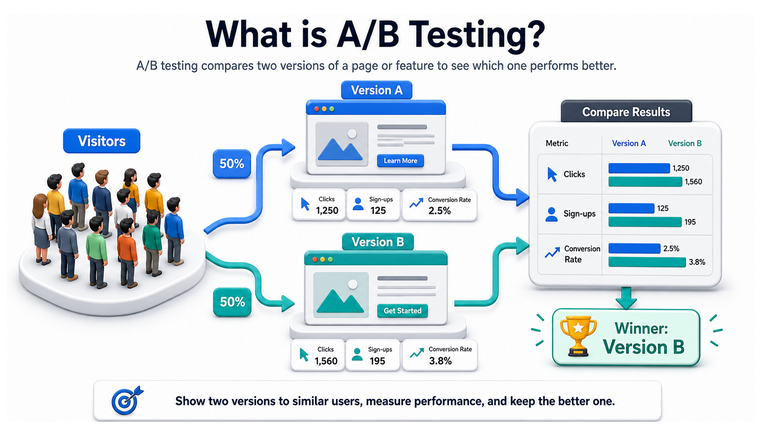
Image Generated: ChatGPT
Both variants run at the same time on equivalent traffic, so external factors (seasonality, day of week, marketing pushes) affect both equally — the only difference left is the change being tested.
It Reduces the Blast Radius via Traffic Splitting
A/B testing replaces the question “which version do we think is better?” with “which version performs better when real users encounter it under comparable conditions?” This can be tested by running two or more variants concurrently against equivalent traffic. Success will be defined in advance through measurable outcomes such as conversion, activation, revenue per user, and retention, rather than relitigated after the fact.
This shifts the locus of authority on product decisions away from internal opinion and toward observed user behavior, which is both more accurate and more defensible across teams. The classic illustration is Google’s test of 41 shades of blue for hyperlinks, which, by the company’s own disclosure, surfaced a single shade that delivered an estimated $200 million in additional annual ad revenue, a decision a designer would never have made alone.
It Reduces Release Risk Through Phased Exposure
Feature flags, traffic splitting, and rollback controls give teams a dial instead of a switch. A new pricing page can be exposed to 1% of traffic, then 5%, then 25%, with guardrail metrics like error rate, latency, churn signal, support ticket volume, monitored at each step. If something degrades, the change is reversed without a redeployment. The blast radius of any single change collapses from the entire user base to a controlled cohort, and the cost of being wrong about a release drops by an order of magnitude.
It Makes UX Changes Easier to Test Without Full Rebuilds
When the application separates presentation from business logic, navigation patterns, onboarding flows, form designs, calls to action, pricing displays, and recommendation surfaces can be varied independently of the core systems underneath. Teams can ship a navigation experiment without touching the auth layer, or test a checkout copy change without redeploying payment infrastructure. The result is a product that improves continuously at the surface while remaining stable at the foundation.
It Makes Personalization More Reliable
Rather than assuming a segment-specific experience will work, teams test it. A variant aimed at enterprise users on annual plans is run against the shared experience for that same segment, and the rule is only codified if it actually outperforms. HanesBrands integrated its first-party customer data with controlled experimentation via Adobe Target, resulting in a 41% lift in conversions by delivering more relevant, personalized experiences to identified segments. GIS software firm Esri ran a sustained personalization and testing program with the same toolset and saw a 25% increase in conversions across its digital properties. Crucially, both numbers were measured against tested baselines; they reflect what personalization actually added rather than what stakeholders hoped it would. This converts personalization from a thesis into a portfolio of validated rules, each of which earned its place.
How to Build an A/B Testing Layer Within Your App Development Process
Experimentation is rarely a single decision; it’s a series of architectural choices that compound. Whether the team is starting a greenfield experiment-driven application or retrofitting an existing one, the work falls into four overlapping concerns: mapping where validation is needed, building the technical foundation for controlled releases, designing for changeable experiences, and connecting every experiment or test run to measurement and cleanup.
Start by Mapping Where Product Decisions Need Validation
Before adopting any tooling, teams need a clear picture of where uncertainty actually lives in the product. In a new application, this happens during architecture planning: which surfaces will carry the most consequential decisions, and which will need to evolve fastest? In an existing application, it starts with an honest review of current user flows, hard-coded logic, and high-impact pages.
Common candidates for validation include:
- Onboarding journeys
- Pricing and plan pages
- Checkout and lead forms
- Search and recommendation logic
- Dashboard layouts
- Notification triggers
- High-traffic user workflows
- Features with low adoption or high drop-off
- Existing flows that are difficult to modify or roll back
The output of this exercise is a prioritized map of testable areas, the surfaces most likely to repay investment in experimentation infrastructure.
Build the Technical Layer for Controlled Releases
With the testable areas identified, the next concern is the plumbing that enables controlled releases. This is the layer that decouples deployment from release: code can ship to production while remaining inactive, gated, or visible only to specific cohorts.
The core capabilities of this layer include:
- Feature flags
- Gradual rollouts
- Kill switches
- Beta access controls
- Control and variant groups
- Traffic allocation
- Segment-based releases
- Variant persistence across sessions
- Exclusion rules for overlapping experiments
In a greenfield application, this layer is built into the release architecture from day one. In an existing application, it is more often introduced gradually on the highest-priority surfaces identified in the previous step, without rebuilding the entire product.
Design the Application So Experiences Can Be Changed Without Rebuilds
Controlled releases are necessary but not sufficient. If the underlying components are too tightly coupled, even a flagged experiment becomes expensive to set up. The third concern is making the application itself adaptable.
Design and refactoring patterns that support this include:
- Modular, purposeful UI components that can be swapped or recomposed without touching unrelated code
- Config-driven layouts that read structure and content from a configuration source rather than hardcoding it
- Dynamic content blocks that allow copy, imagery, and calls to action to vary without code changes
- API-driven feature delivery, where the server tells the client what to render rather than the client deciding statically
- Reusable experiment containers that wrap variant logic in a consistent, auditable pattern
- Separation of business logic and presentation logic, so surface-level experiments don’t risk core system stability
- Selective refactoring of tightly coupled components, focused only where testing frequency justifies the investment
- Testing different flows without changing core application logic, so experiments live at the edges rather than the center
The principle here is restraint: rebuild the application’s testable surfaces, not the application itself. Selective refactoring almost always outperforms a rewrite.
Connect Every Experiment to Measurement, Governance, and Cleanup
The final concern is operational. A mature experimentation layer is closed-loop by design, with every test connected to analytics, ownership, and a defined endpoint.
This layer should cover:
- Event tracking instrumented for every variant and key user action
- Conversion goals defined before the experiment starts, not after results come in
- Retention, revenue, and engagement metrics measured beyond the immediate funnel
- Guardrail metrics such as error rate, latency, churn, and drop-offs, to catch unintended harm
- Hypothesis definition that states what is being tested and what would constitute success or failure
- Sample size and test duration calculated up front based on the expected effect size and traffic
- QA for every variant, including cross-device and cross-browser checks
- CI/CD checks for experiment logic and tracking events, so broken instrumentation is caught before launch
- Experiment ownership and documentation, with a named owner accountable from launch through cleanup
- Privacy and access controls aligned with regulatory and contractual obligations
Together, these four building blocks turn A/B testing from an isolated activity into an architectural capability, one that compounds over time rather than fragmenting the codebase.
Conclusion: Experimentation Is Becoming Part of Product Architecture
A/B testing started as a marketing tactic, evolved into a UX practice followed by the expert UX designers, and is now becoming a property of well-designed product architectures. The teams treating it that way build applications that are measurable by default, releasable in controlled increments, adaptable without rewrites, and easier to improve year over year. The teams that don’t end up rediscovering the same lessons through outage postmortems and underperforming features.
The shift ahead is not whether to experiment but how deeply experimentation is wired into the system. As AI-assisted development accelerates the rate at which product variants can be generated, the constraint moves from idea generation to disciplined validation. Architectures built for continuous experimentation will be the ones that turn that acceleration into a durable product advantage rather than faster noise.

 Give feedback about this article
Were sorry to hear about that, give us a chance to improve.
Error: Contact form not found.